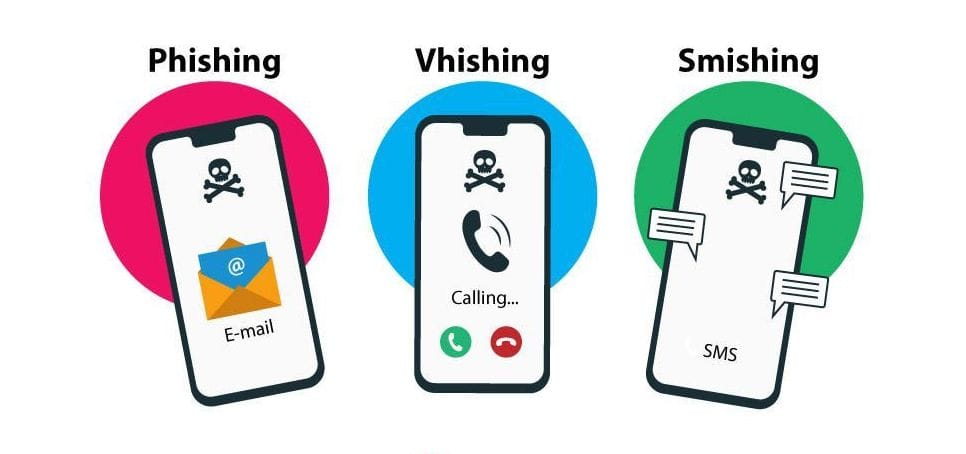
These three terms Phishing, Vishing, and Smishing are all forms of social engineering attacks that aim to trick you into giving away sensitive information, but they differ primarily by the communication method they use. Here is a detailed breakdown of each:
Phishing (Email Deception)
Phishing is the original and most common form of this scam family. It uses fraudulent emails and fake websites to steal your sensitive data, like login credentials, credit card numbers, or other personal information.
A scammer sends an email that appears to be from a trusted source (e.g., your bank, Netflix, Amazon, PayPal, or a major corporation). The email often contains an urgent warning (“Your account has been suspended“) or an enticing offer (“You’ve won a prize“).
The email instructs you to click a link, which takes you to a fake login page that looks nearly identical to the real one. When you enter your credentials, the scammer harvests them. Alternatively, the email may contain a malicious file attachment that installs malware.
Red Flags: Spelling/grammar errors, an unusual sender email address (e.g.,
micros0ft.com), a generic greeting (“Dear Customer“), and a sense of extreme urgency.
Vishing (Voice Phishing)
Vishing is the combination of “Voice” and “Phishing.” It uses telephone calls to trick victims into revealing personal or financial information. A scammer calls you, often using technology like Caller ID spoofing to make the call appear to come from a legitimate number (e.g., a local police department, a government agency, or your bank’s fraud department).
The scammer (who may be a live person or a pre-recorded robocall) uses fear or authority to create panic, such as claiming there is a warrant out for your arrest, that your computer has a serious virus, or that a large fraudulent transaction has just occurred on your account.
To get you to give them sensitive data verbally (like your credit card PIN, date of birth, or One-Time Password/OTP) or to convince you to transfer money to a “safe” account (which is actually the scammer’s account).
Red Flags: Unsolicited calls that demand immediate payment or sensitive information over the phone, threats of legal action, and a refusal to let you hang up and call them back on the company’s official, published phone number.
Smishing (SMS Phishing)
Smishing is a blend of “SMS” (Short Message Service/Text Message) and “Phishing.” It leverages the higher trust people tend to have in text messages compared to emails. Scammers send text messages, impersonating a trusted entity like a delivery service, a major retailer, or a bank.
The message often creates an urgent scenario related to a mobile-centric activity, such as a failed package delivery (“Click here to reschedule”) or a bank fraud alert (“A large payment was just approved. Reply ‘NO‘ or click here to block”).
To trick you into clicking a malicious, shortened link that redirects you to a fraudulent website designed to steal your login or financial details, or sometimes to download malware onto your mobile device.
Red Flags: Unexpected texts with short, unidentifiable links (e.g.,
bit.ly/xxxx), messages from an unknown 10-digit number pretending to be a major corporation, and any message that asks you to click a link to verify an account or delivery issue.
Would you like some proactive security tips on how to avoid falling for these social engineering scams?