The Deep Web comprises the enormous portion of the World Wide Web that standard search engines like Google, Bing, or Yahoo fail to index. In simple terms, it’s all the data and web pages that you cannot find through a regular web search.
The Internet Iceberg Model
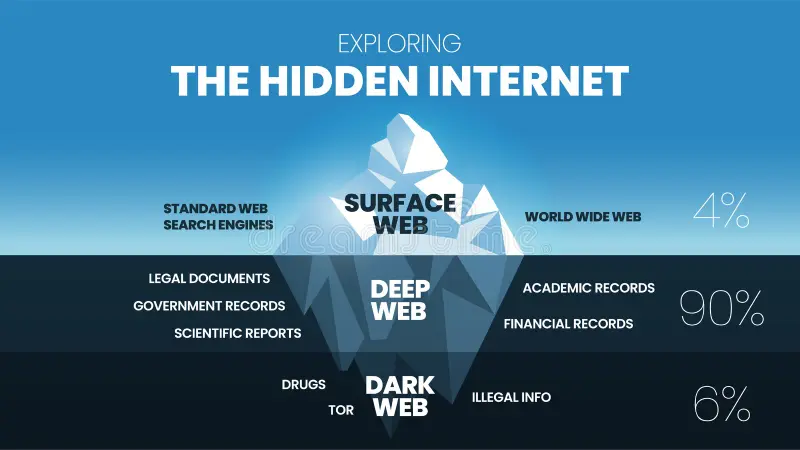
To understand the Deep Web, it’s often helpful to picture the internet as an iceberg:
- Surface Web: This is the very tip of the iceberg, making up only about 4-5% of the internet. Search engines index all its publicly accessible pages, including this answer page, news sites, Wikipedia, and public social media profiles.
- Deep Web: This massive submerged portion makes up 90-95% of the internet. It contains content that search engines do not index, even though you access it every day using a normal browser (Chrome, Firefox, etc.).
- Dark Web: This is a very small, specific, and intentionally hidden part of the Deep Web that requires specialized software (like the Tor Browser) to access, as you learned previously.
What is on the Deep Web?
The Deep Web is not inherently malicious. Its content is simply private or protected. Examples of Deep Web content include:
- Private Data: Your personal accounts, such as your Gmail inbox, bank account dashboard, medical records, or your private social media posts.
- Paywalled Content: Subscription services, academic journals (e.g., JSTOR), professional databases, or news archives that require a paid login to access.
- Dynamic Pages: Content generated in real-time in response to a user query (like a flight status result or a custom inventory check) which doesn’t have a permanent, static URL for a search engine to index.
- Internal Networks: Corporate intranets, internal government documents, or university portals only accessible to employees or registered students.

The Key Difference: Indexing
The main reason content is in the Deep Web is that search engine web crawlers cannot get to it. Following are the reasons behind it:
- Behind a password or login screen.
- Hidden by a CAPTCHA.
- Blocked by code on the site owner’s request (robots.txt).
- Stored in non-public, unlinked databases.
So, while the Dark Web is hidden for anonymity and often illicit purposes, the Deep Web is simply where your everyday private and protected information lives.