Baiting is a social engineering technique that leverages a person’s curiosity or greed to compromise their security. It is essentially the Trojan Horse of the digital age, where an attacker leaves a lure (the bait) to entice a victim into a trap that leads to malware infection or the theft of sensitive information.
Unlike phishing, which relies on digital communication like email or text, baiting often bridges the gap between the physical and digital worlds.
How Baiting Works?
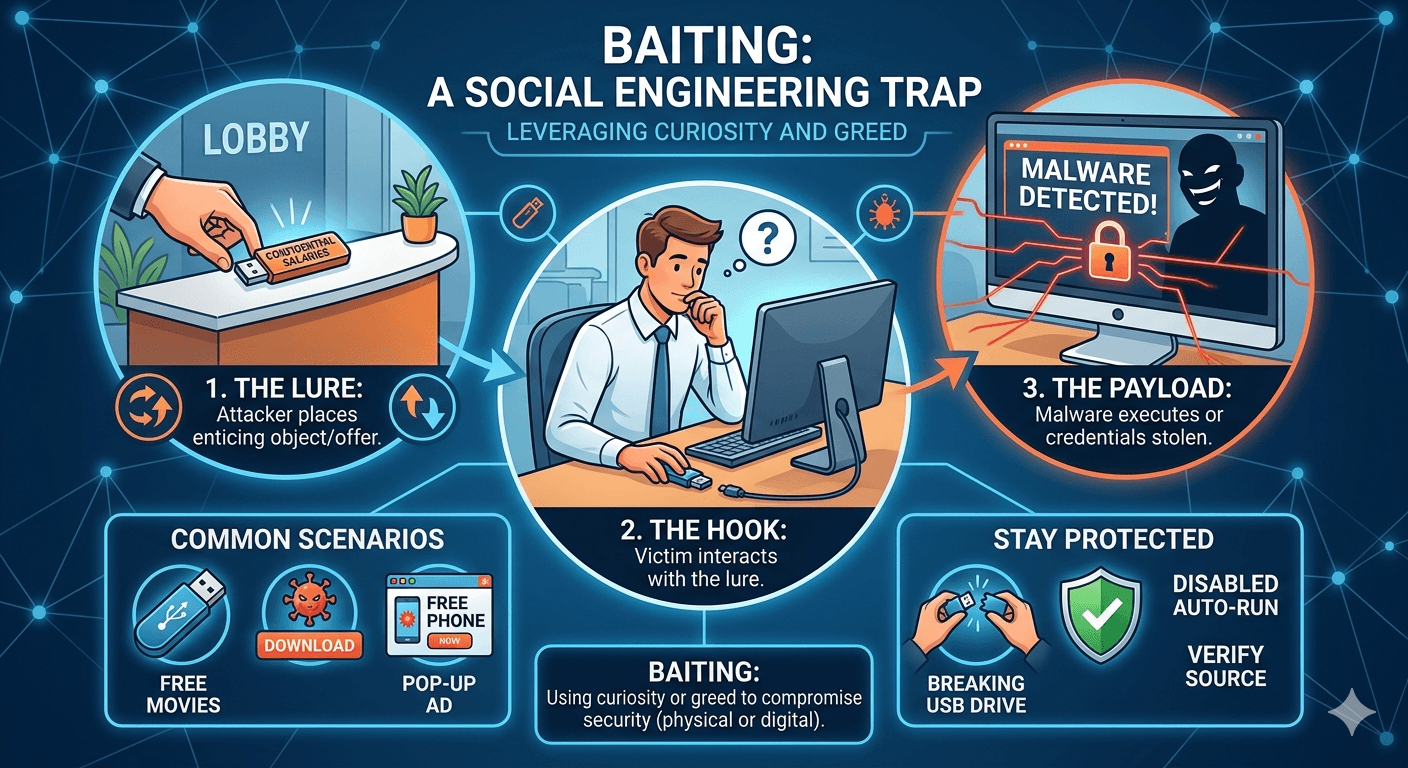
Baiting typically follows a simple three-step process:
- Lure: The attacker places an enticing object or offer in a location where a potential victim is likely to find it.
- Hook: The victim, driven by curiosity or the promise of a reward, interacts with the lure.
- Payload: Once the victim interacts with the bait, the system executes malicious software or directs the victim to a site designed to steal credentials.
Common Baiting Scenarios
Baiting can take several forms, ranging from physical media to digital advertisements:
- Physical Media (The “USB Drop”): An attacker leaves a malware-infected USB drive, CD, or external hard drive in a high-traffic public area (e.g. a lobby, parking lot, or breakroom). The drive might be labeled with something intriguing like “Executive Salaries” or “Confidential Project Photos“. When a curious employee plugs it into their computer, the malware automatically installs.
- Digital Downloads: Malicious actors often use the promise of free software, movies, or music to bait users. A website might offer a free cracked version of a popular program, but the download package includes a remote access trojan (RAT) or ransomware.
- Online Special Offers: This can appear as a pop-up or social media ad offering an unbelievable deal, such as a free high-end smartphone or a gift card. To claim the prize, the user is prompted to enter personal details or download a verification file.
Baiting vs. Phishing
- Primary Driver
- Baiting: Curiosity or Greed.
- Phishing: Urgency, Fear, or Authority.
- Medium
- Baiting: Physical (USB) or Digital (Downloads).
- Phishing: Communication (Email, SMS, Voice).
- Interaction
- Baiting: Victim seeks out the reward.
- Phishing: Attacker reaches out to the victim.
How to Stay Protected?
- Never Use Unknown Hardware: Avoid plugging in USB drives or external devices found in public or sent by unverified sources.
- Disable Auto-Run: Ensure that your computer settings do not automatically execute programs when a new media device is connected.
- Verify the Source: Only download software and files from official, trusted websites.
- Security Awareness: Training employees to recognize the risks of found items is the most effective defense against physical baiting attacks.