
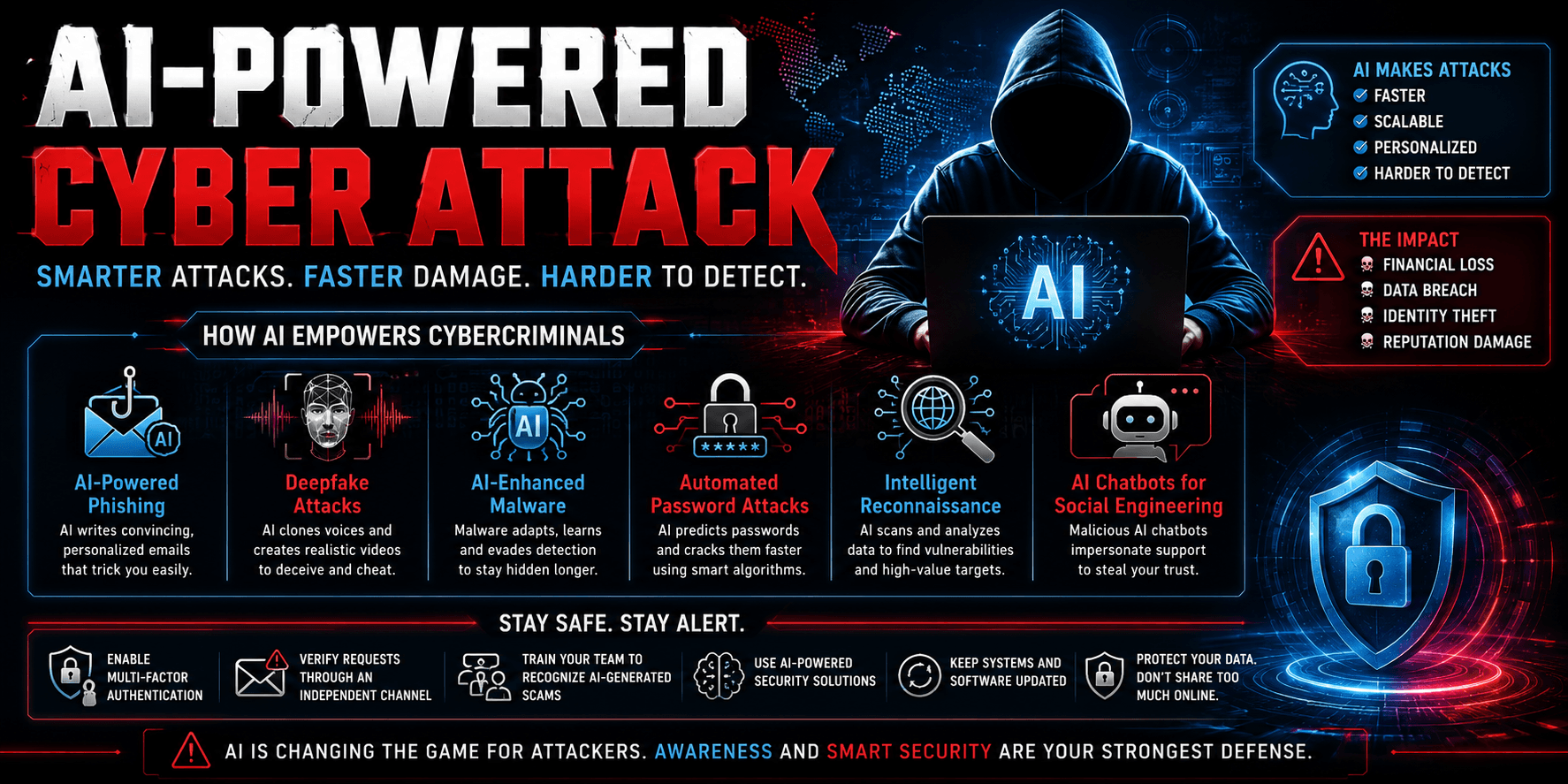
An AI-powered cyber attack is a cyber attack in which attackers use artificial intelligence (AI) to automate, improve, or scale malicious activities. Instead of relying only on manual techniques, cybercriminals leverage AI to make attacks faster, more convincing, and harder to detect.
How AI Changes the Threat Landscape?
Traditional cyberattacks usually present a tradeoff: volume vs. sophistication. A spam campaign reaches millions but looks fake, while a spear-phishing attack on a CEO is convincing but takes weeks to research. AI breaks this trade-off by allowing attackers to execute highly targeted attacks at massive scale.
Key Types of AI-Driven Attacks
- Autonomous & Polymorphic Malware: Malware strain creators use AI algorithms to rewrite its underlying code on the fly. By altering variable names, execution paths, and encryption keys each time it moves to a new machine, the payload evades signature-based antivirus detection while executing the same underlying malicious payload.
- Generative Social Engineering & Deepfakes: LLMs enable threat actors to scrape public records, social media, and breached data to generate context-aware phishing emails automatically. Beyond text, generative voice and video models allow attackers to bypass traditional multi-factor authentication (MFA) prompts or conduct Business Email Compromise (BEC) fraud over live video conferences.
- Automated Reconnaissance and Vulnerability Discovery: AI agents can scan complex networks, aggregate threat intelligence, and test potential zero-day exploit paths faster than human security analysts. They map out network topologies, identify high-value targets (like domain controllers or sensitive databases), and execute lateral movement automatically.
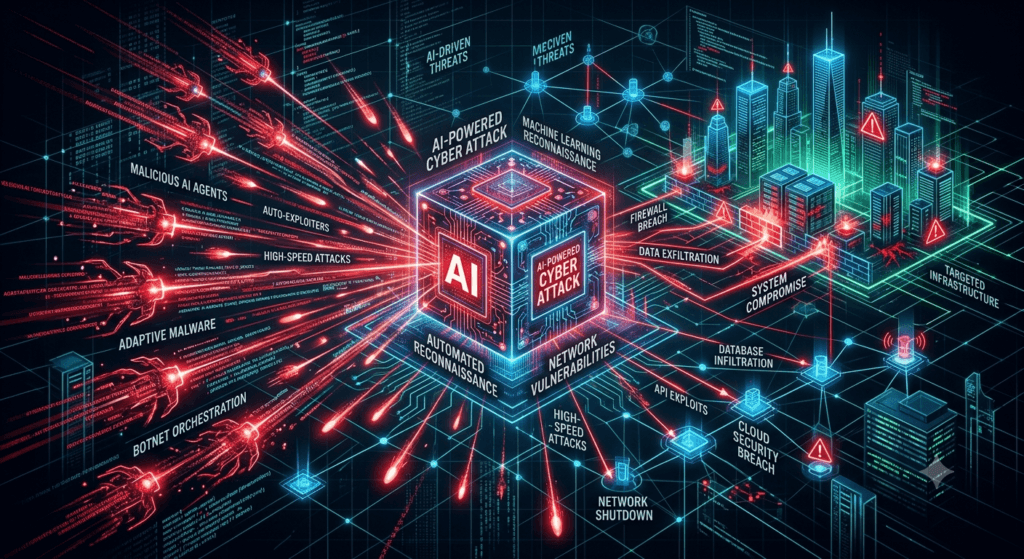
- Adversarial Machine Learning (Attacking AI itself): Attackers also direct AI threats against defensive AI systems:
- Data Poisoning: Corrupting the training data used by defensive models so they fail to recognize malicious activity.
- Model Inversion & Extraction: Querying a proprietary AI model repeatedly to steal its underlying weights or reconstruct sensitive training data.
- Prompt Injection: Manipulating enterprise LLMs or AI assistants via carefully crafted prompts to bypass guardrails and leak internal company data.
Why AI-powered Attacks are Dangerous?
- Speed: Thousands of attacks can be launched simultaneously.
- Personalization: Messages are tailored to each victim.
- Automation: Minimal human effort is required after setup.
- Scalability: One attacker can target millions of users.
- Evasion: AI helps bypass traditional security defenses.
How to Defend Against AI-powered Cyber Attacks?
Defending against automated, adaptive threats requires moving away from static rules and manual workflows. Modern defense strategies rely on AI-driven security solutions that can analyze anomalies and isolate compromised endpoints in milliseconds, matching the speed of the attacker.
- Enable Multi-Factor Authentication (MFA).
- Train employees to recognize AI-generated phishing attempts.
- Verify financial or sensitive requests through an independent communication channel.
- Use AI-powered email security and endpoint detection solutions.
- Keep operating systems and software updated.
- Deploy behavior-based threat detection instead of relying only on signature-based antivirus.
- Limit the exposure of personal and organizational information on public websites and social media.
Real-World Examples
- Business Email Compromise (BEC): Attackers use AI to write convincing executive emails requesting urgent wire transfers.
- Voice-cloning scams: Criminals clone a family member’s or executive’s voice to request money or confidential information.
- AI-generated phishing campaigns: Large-scale phishing operations produce unique emails for each target, reducing the effectiveness of spam filters.
An AI-powered cyber attack is any cyber attack that uses artificial intelligence to make malicious activities more intelligent, automated, scalable, and convincing. While AI is also strengthening cybersecurity defenses, it is simultaneously giving attackers powerful new tools, making awareness and modern security practices increasingly important.