
Artificial Intelligence (AI) has become the driving force behind modern technology. From self-driving cars and facial recognition systems to fraud detection and medical diagnosis, AI is transforming industries worldwide. However, the effectiveness of AI depends entirely on one crucial element – data.
The popular saying “Garbage In, Garbage Out (GIGO)” perfectly describes AI systems. If an AI model is trained using manipulated or malicious data, its predictions and decisions become unreliable. Cybercriminals have recognized this weakness and developed a dangerous attack technique known as AI Data Poisoning.
Unlike traditional cyberattacks that target networks or software vulnerabilities, AI data poisoning attacks target the learning process itself, making AI systems unreliable while appearing to function normally. Because these attacks often remain undetected until the AI starts making incorrect decisions, they pose a significant challenge for organizations deploying machine learning systems.
This article explores AI Data Poisoning in detail, including its working principles, attack methods, real-world examples, impacts, detection techniques, and preventive measures.
What is AI Data Poisoning?
AI Data Poisoning is a cyberattack in which an attacker intentionally inserts malicious, misleading, or manipulated data into the dataset used for training or updating an AI or Machine Learning (ML) model. The objective is to alter the model’s behavior so that it:
- Produces incorrect predictions.
- Makes biased decisions.
- Fails under specific conditions.
- Allows attackers to bypass security.
- Damages trust in AI systems.
Instead of attacking the AI software directly, attackers corrupt the knowledge the AI learns from.
Why AI Depends on Data?
Machine Learning models learn patterns from historical data.
- A spam detection AI learns from Genuine and Spam emails.
- A medical AI learns from X-rays, MRI Scans and Disease labels.
- A fraud detection AI learns from Legitimate and Fraudulent transactions.
If attackers manipulate these datasets, the AI learns incorrect relationships. The result is an AI system that confidently makes wrong decisions.
How AI Data Poisoning Works?
A typical data poisoning attack follows several stages.
Step 1: Reconnaissance
The attacker studies data collection methods, data sources, AI training pipelines and update frequency.
Step 2: Access to Training Data
Attackers gain access by compromising data pipelines, uploading fake user-generated content, exploiting crowdsourced datasets, insider threats and open-source dataset manipulation.
Step 3: Inject Malicious Data
The attacker inserts poisoned samples. These samples appear legitimate but contain carefully designed manipulations.
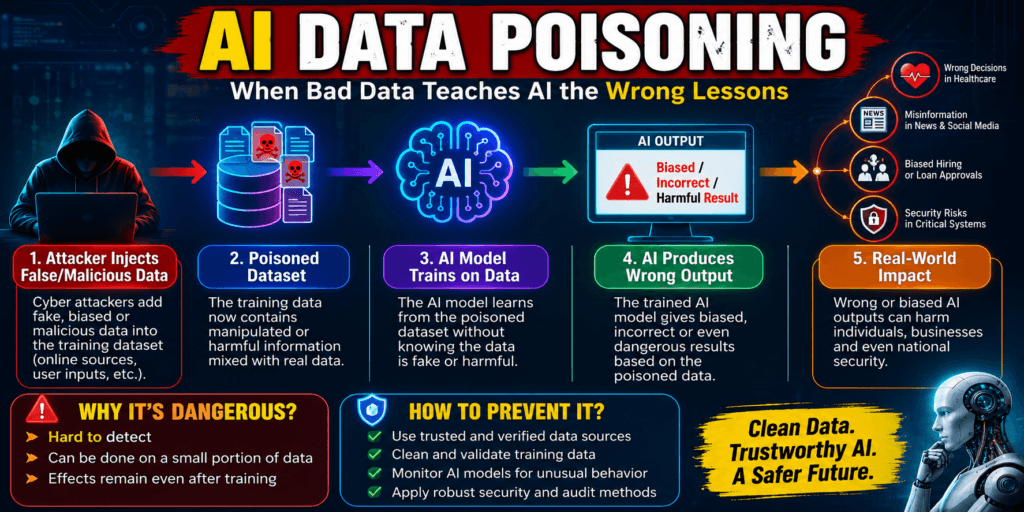
Step 4: AI Model Training
The AI trains using both legitimate and poisoned data. Since AI assumes training data is trustworthy, it incorporates the malicious patterns.
Step 5: Model Deployment
The compromised AI enters production. At this point the attack may remain invisible until specific situations trigger incorrect behavior.
Types of AI Data Poisoning Attacks
- Label Poisoning: The attacker changes the labels of training data. Example: Images of cats are labeled as dogs. The AI gradually learns incorrect classifications.
- Feature Poisoning: Instead of changing labels, attackers manipulate the features. Example: Adding subtle image modifications while keeping the correct label. The AI begins associating unrelated features with specific outcomes.
- Backdoor Attacks: Backdoor poisoning is among the most dangerous forms of AI attacks. The attacker inserts hidden triggers into training data. Example: Every image containing a small yellow sticker is labeled as “Stop Sign”. Later, any stop sign with that sticker causes the AI to behave incorrectly.The AI appears perfectly normal under regular testing.
- Availability Attacks: The goal is not targeted manipulation but degrading the model’s overall performance. Large amounts of poisoned data reduce accuracy dramatically.
- Targeted Poisoning: Only specific predictions are manipulated. Example: A fraud detection AI ignores transactions from one particular attacker. Everyone else is classified correctly.
Sources of Poisoned Data
Data poisoning can occur through multiple channels.
- Crowdsourced Data: Many AI systems rely on public contributions. Attackers submit fake or manipulated samples.
- Open Datasets: Researchers often download datasets from public repositories. If attackers compromise these datasets, thousands of AI models may become vulnerable.
- User Feedback: Recommendation systems continuously learn from user interactions. Fake ratings, reviews, and clicks can poison future recommendations.
- Insider Threats: Employees with access to training pipelines may intentionally insert malicious samples.
- Third-Party Vendors: Organizations purchasing datasets from external providers risk receiving poisoned data.
Consequences of AI Data Poisoning
- Financial Losses: Incorrect AI predictions may lead to Fraud, Wrong investments and Business disruption.
- Security Risks: A poisoned cybersecurity AI may fail to detect malware or network intrusions.
- Healthcare Risks: Misdiagnosis can occur if medical AI is trained using poisoned datasets. Patient safety becomes a serious concern.
- Reputation Damage: Organizations deploying compromised AI may lose customer trust.
- Legal Consequences: Incorrect AI decisions can lead to lawsuits and regulatory penalties, particularly in sectors such as healthcare, finance, and public services.
Detecting AI Data Poisoning
Detection is difficult because poisoned samples often resemble legitimate data. Several techniques help identify suspicious training data.
- Statistical Analysis: Outliers and abnormal patterns can indicate poisoning.
- Data Validation: Verify Source authenticity, Metadata, Integrity and Collection history.
- Human Review: Experts manually inspect sensitive training datasets.
- Robust Machine Learning: Specialized algorithms are designed to tolerate a limited amount of poisoned data.
- Cross-Dataset Validation: Training using multiple independent datasets helps identify inconsistencies.
Preventing AI Data Poisoning
- Secure Data Pipelines: Protect data collection systems using encryption, authentication and access controls.
- Trusted Data Sources: Use verified, reputable, and well-documented datasets whenever possible.
- Dataset Auditing: Regularly inspect datasets for anomalies, duplicate entries, suspicious labels, and unexpected distributions.
- Access Control: Restrict who can upload data, modify labels and retrain AI models.
- Continuous Monitoring: Track model accuracy, prediction drift, and unusual behavioral changes after retraining.
- Differential Privacy: Privacy-preserving training techniques can reduce the influence of individual malicious records.
- Federated Learning with Validation: When training occurs across multiple devices or organizations, validate incoming model updates before incorporating them into the global model.
- Adversarial Training: Train AI systems using simulated attack scenarios to improve resilience against poisoning attempts.
Best Practices for Organizations
Organizations deploying AI should adopt a defense-in-depth strategy:
- Maintain strong governance over data collection and labeling.
- Verify the integrity and provenance of datasets.
- Use secure, monitored data pipelines.
- Limit retraining to trusted and validated data.
- Perform regular security audits of AI systems.
- Test models against poisoning and backdoor scenarios.
- Monitor for model drift and unexpected behavior.
- Keep detailed logs for forensic investigations.
- Train employees on AI-specific security risks.
- Develop an incident response plan for AI security events.
Future Challenges
As AI becomes integrated into critical infrastructure and public services, data poisoning attacks are expected to become more sophisticated. Emerging trends include:
- Poisoning datasets used to train large language models (LLMs).
- Supply-chain attacks targeting shared datasets and pre-trained models.
- Coordinated campaigns that manipulate public data sources at scale.
- AI-assisted attackers generating convincing poisoned samples.
- Challenges in securing continuously learning and autonomous AI systems.
Defending against these threats will require advances in secure machine learning, better data governance, and ongoing collaboration between AI researchers and cybersecurity professionals.
Conclusion
AI Data Poisoning is one of the most significant security threats facing modern machine learning systems. By corrupting the data used to train AI models, attackers can subtly influence decisions, introduce hidden backdoors, degrade performance, or undermine trust in AI-powered applications.
As organizations increasingly rely on AI for mission-critical tasks, protecting the integrity of training data is just as important as securing networks and applications. Robust data validation, secure data pipelines, continuous monitoring, and resilient machine learning techniques are essential components of an effective AI security strategy.
In the coming years, AI security will not only be about protecting models from external attacks but also about ensuring that the data shaping those models remains accurate, trustworthy, and resistant to manipulation. Organizations that prioritize data integrity today will be better equipped to build reliable, secure, and trustworthy AI systems tomorrow.